Slavoj Zizek uses Lacanian psychoanalytic theory to investigate the role played by objects in Alfred Hitchcock’s films.
Zizek’s observations, and the theoretical tools provided by Lacan, will help me narrate my story, that of the human-machine-digital environment relationship. This story is inherently complex because each component exists in a different realm of perception.
Lacan developed this diagram in his Seminar Encore in 1975. It is interpreted that:
The Imaginary is the beginning. He explains that when we first perceive ourselves visually, we become aware of our identity and our relationship with others; he calls this the mirror stage.
The Symbolic refers to exchange; the most basic form could be communication.
The exchange of words, the gift of speech–the symbolic is essentially a linguistic dimension.
The Real refers to what is impossible for us to apprehend, that which is outside of language and fantasy. It has a resistance to symbolization.
The Real is the impossible because it is impossible to imagine, impossible to integrate into the symbolic order, and impossible to attain in any way. – The Real also has connotations of matter, implying a material substrate underlying the imaginary and the symbolic.
S(A) The Object of Exchange Zizek makes a connection with Hitchcock between these realms. The object of exchange sets the action in motion around which a story may be organized. It is the crystallization of the symbolic structure. An example of this would be the ring that unveils the mystery in Rear Window. Lisa (Grace Kelly) finds the ring while searching Thorwald’s apartment. We see the ring through the point of view of Jeff’s binoculars; in that moment we cannot deny Thorwald’s guilt.
In my film the object of exchange is the device that enables social exchange. It is like a prosthetic, necessary for social relations. It encompasses the convergence of different technologies that enable inter-dependence and interaction. The designed product is a medium of social relations.
Object Petit a: The McGuffin The function of the Object Petit a or The McGuffin is to set the story in motion. It has a deep meaning for the characters in the story. Sometimes we cannot even see the object, but we know that it exists. This is the connection that exists between the Real and the Symbolic: between the signifier and unattainable desire. It is an object that drives our desires but that is impossible to attain. In John Huston’s The Maltese Falcon the mysterious object drives the story, it is the object of desire, ever-elusive. In Hitchcock’s Notorious, the McGuffin drives an agent from the C.I.A. played by Cary Grant, and his partner, Ingrid Bergman, in pursuit of stolen uranium, hidden inside wine bottles in Rio de Janeiro.
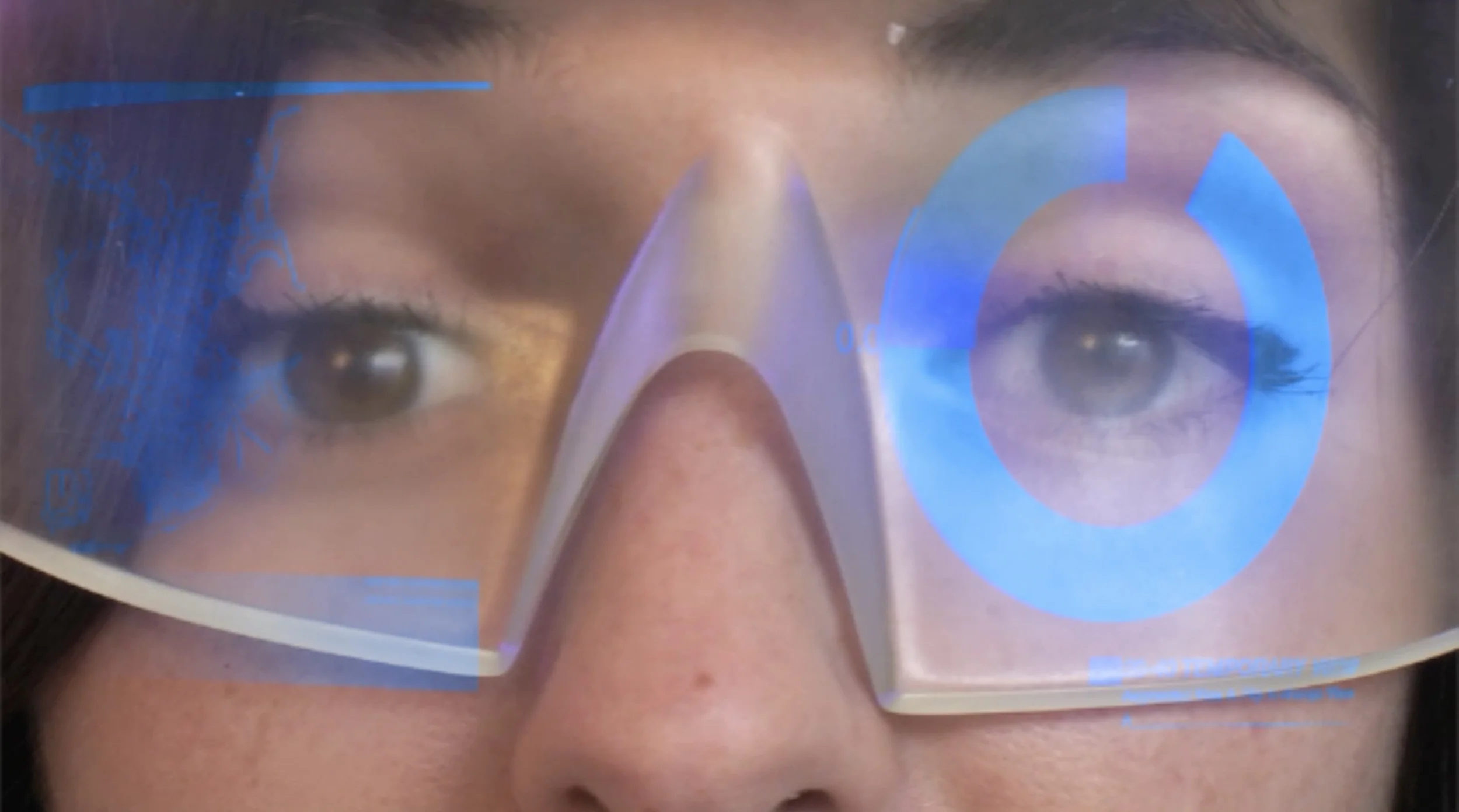
In my film the McGuffin is the augmentation [you might need to say more about what you mean by “augmentation” here] produced by the device. It compensates for the lack of the other, enabling the addition of an extra layer to reality, virtual and artificial.
I intersected the Hermeneutic Object with The Hitchcockian Object.
The Object Phi: Digital Ecology. The Object Phi has an oppressive presence. It exists between the Real and the Imaginary. It returns in an unrecognizable and often horrific form, an effect of our fantasies of control, the distraction and denial that characterize culture. Like a hurricane that is produced by global warming, or the birds in Hitchcock’s The Birds: were, at the beginning of the film the birds are imprisoned in a small cage and at the end the table is turned and we are presented with our characters trapped inside a house by a massive, oppressive presence represented by thousands of birds.
Electronic objects and the networks that enable them create the digital ecology. We are not even sure of the possible physical consequences of the electro-magnetic fields. The digital ecology is presented in my film as an inescapable presence, ubiquitous and oppressive.